
Welcome to the future of social media marketing—a landscape reshaped so profoundly by AI that strategies from just a few years ago now feel almost quaint. As a senior digital strategy consultant, I’ve watched closely as AI evolved beyond mere content generation into a sophisticated orchestrator of entire campaigns, capable of unprecedented personalization, emotional insight, and seamless commerce integration. This week, let’s unpack the seismic shift from “Generative AI” to “Agentic AI” and explore the key pillars transforming how brands connect—and convert—on social platforms in 2026.
As AI reshapes how brands plan, execute, and optimize campaigns, marketers can no longer rely on outdated tactics. To stay relevant in 2026, professionals must actively learn social media marketing with AI through structured, hands-on education. This shift is driving massive demand for an advanced social media marketing course that teaches real-world AI tools, automation workflows, and strategy—not just theory.

The Core Shift: From Generative to Agentic AI in Marketing
Back in the early 2020s, AI tools primarily played a supporting role in social media marketing—churning out posts, captions, and creative assets based on prompts. We called this phase “Generative AI” because the technology’s power lay in content creation alone.
But fast forward to 2026, and AI has stepped up to become “Agentic AI”—autonomous, decision-making systems that don’t just generate content but run entire marketing campaigns end-to-end, adapting to real-time data and driving results with minimal human oversight.
This leap is nothing short of revolutionary. Instead of marketers manually tweaking every ad or post, Agentic AI software handles everything from budget allocation and audience targeting to creative iteration and cross-channel optimization. The human role has shifted toward strategy and exception management, letting AI do the heavy lifting. But this isn’t just automation—it’s a new partnership between human insight and machine precision that’s redefining what’s possible in social marketing.
This evolution explains why traditional tutorials are no longer enough. Modern marketers increasingly seek an AI social media marketing course or social media marketing training 2026 that goes beyond content creation and focuses on building, managing, and supervising agentic systems in real campaigns.
Hyper-Personalization: The Era of Singularly Customized Content
If personalized content was once a cool feature, hyper-personalization is now table stakes. Thanks to AI’s ability to analyze vast data streams—from browsing habits and purchase history to mood indicators and even micro-moments—social platforms no longer serve “segments” of users. Instead, they deliver uniquely tailored content to each individual, a phenomenon we call the “singularly customized” experience.
Imagine scrolling through your feed and every ad, post, or story is so finely calibrated that it feels crafted just for you. Algorithmic models factor in your latest emotional state, current context, and predicted intent. Campaigns no longer rely on broad messaging but embrace a thousand micro-campaigns running simultaneously. The result? Engagement rates that are off the charts and consumer relationships that feel deeply personal rather than generic.
Emotion AI: Decoding Sentiment Velocity and Micro-Emotions
Campaign success is no longer measured solely by clicks or impressions. In 2026, platforms deploy Emotion AI to analyze sentiment velocity—the speed and intensity with which emotions spread through social graphs—and micro-emotions, those subtle facial expressions or language cues that reveal more than words alone.
By tracking how a post makes people feel in real time—joy, frustration, excitement, or skepticism—Agentic AI dynamically adjusts who sees the content next and how it’s framed. This emotional feedback loop can amplify positive vibes or mitigate negative responses by tweaking tone or creative elements instantly. For marketers, this means campaigns are more agile, empathetic, and effective at nurturing not just awareness, but genuine emotional resonance.
Social Commerce: AI Turns Feeds Into Frictionless Storefronts
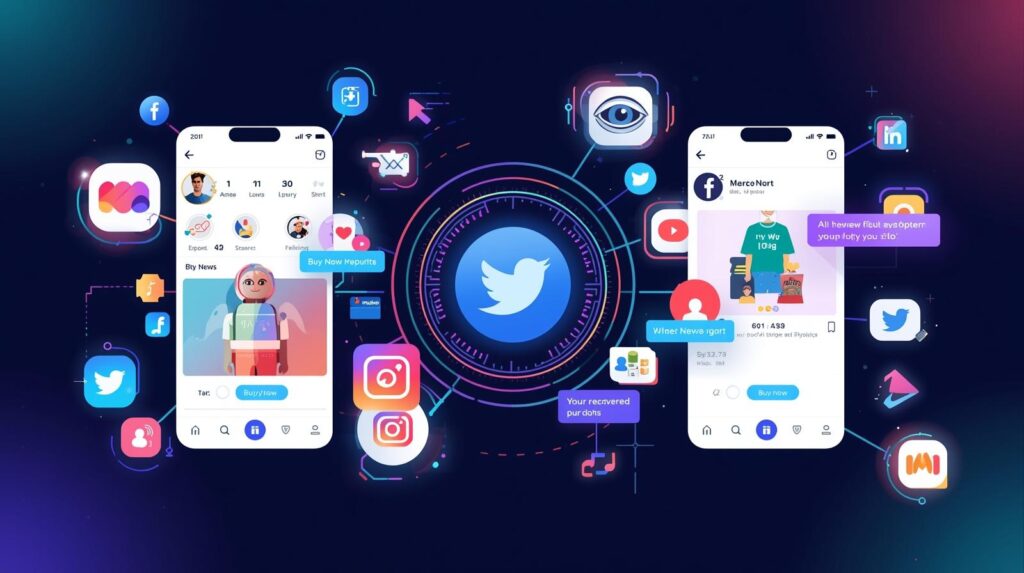
The line between social media and shopping has blurred beyond recognition. AI-powered social commerce is no longer a novelty but an essential channel where discovery, desire, and purchase happen in one seamless flow.
On today’s platforms, AI curates product recommendations directly integrated into users’ feeds, stories, and live streams. It automates inventory visibility, pricing adjustments, and checkout processes, creating what feels like an endless, personalized storefront embedded in everyday social interactions. With omnipresent AI assistance, the social shopping experience is remarkably convenient—no more link clicks or app switching. This frictionless commerce accelerates decision-making and reduces abandonment, ultimately boosting lifetime value.
The Human Element: Navigating the Authenticity Paradox
With AI capable of generating infinite, hyper-tailored content, one might wonder: where do human storytellers fit in? Enter the “Authenticity Paradox.” As AI content floods feeds, audiences crave genuine human voices now more than ever. Authenticity isn’t just desirable—it’s a competitive advantage.
Brands that master the paradox use AI for scale and efficiency but lean into human-led storytelling to build trust, cultural relevance, and emotional depth that machines can’t replicate. This means investing in creators, community managers, and brand advocates who bring nuance, empathy, and lived experience. AI is an enabler, but the soul of social marketing in 2026 belongs to human authenticity—stories that resonate because they feel real, vulnerable, and relatable.
2026 Survival Checklist for Marketers
- Embrace Agentic AI: Integrate autonomous AI tools but keep a strategic human hand guiding overall objectives and exceptions—skills now taught in every future-ready digital marketing course with AI tools.
- Prioritize Hyper-Personalization: Develop content strategies that serve uniquely tailored experiences at scale using advanced data modeling.
- Leverage Emotion AI Insights: Monitor sentiment velocity and emotional signals to continuously optimize messaging and delivery.
- Integrate Seamless Social Commerce: Build or partner with AI-powered storefronts embedded in social feeds to reduce purchase friction and maximize sales.
- Double Down on Authentic Storytelling: Invest in human-driven narratives as differentiation amid growing AI-generated content noise.
- Stay Agile and Data-Driven: Use real-time analytics dashboards to pivot quickly; the social landscape is dynamic, and delay equals lost opportunity.
Closing Thoughts
It’s a thrilling moment to be in social media marketing. AI’s evolution into agentic systems means brands can deliver hyper-personal, emotionally intelligent, and commerce-optimized campaigns like never before. Yet, as technology surges forward, the human spark—our authenticity—remains a beacon that cuts through the noise.
So, for marketers, founders, and aspiring professionals, this transformation highlights a clear reality: success in 2026 requires continuous upskilling. Enrolling in a future-ready social media marketing course that integrates AI strategy, automation, emotion intelligence, and social commerce is no longer optional—it’s essential for staying competitive in an AI-driven landscape.